Expanding the capacity of a Pecron F5000 power station using third-party 51.2V LiFePO4 batteries is a practical way to extend off-grid runtime. By tapping into the expansion battery ports, you can effectively parallelize external energy storage with the internal system. This procedure requires careful voltage matching and proper cabling to ensure the BMS and inverter handle the increased capacity without faults.
⚡ Quick Guide: How to Make It in 9 Steps
- Verify compatibility by measuring port voltage.
- Select a 51.2V LiFePO4 server rack battery.
- Fabricate a custom adapter cable with SB175 connectors.
- Install 40A DC breakers for circuit protection.
- Ensure both battery systems are at 100% SOC.
- Connect the external battery to the expansion port.
- Monitor for inrush current during initial connection.
- Test under load to confirm system integration.
- Verify charging functionality via AC input.
📋 In This Article
- Technical Specifications & Components
- Tools & Materials Used — what you will need for this project
- Verifying Expansion Port Compatibility
- Selecting and Preparing the LiFePO4 Battery
- Testing System Load and Discharge
- Calculating Total Capacity and Charging
- Stress Testing the Inverter Output
- Integrating an External Charger
- Parallel Battery Configuration Tips
- Building the Custom Adapter Cable
- Installing Circuit Protection
- FAQ
📊 Technical Specifications & Components
| System Voltage | 51.2V Nominal |
| Expansion Port Voltage | 54.64V |
| Inverter Load Tested | 1,400W to 6,700W |
| Battery Chemistry | LiFePO4 |
| Connector Type | Anderson SB175 |
| Circuit Protection | 40A DC Breakers |
| Capacity Utilization | 87.3% of 10,240Wh |
| Charging Input | 1,000W AC |
📊 Project Overview & Costs
🔧 Difficulty Level: Medium
⏱️ Time Investment: DIY: 2-3 hours | Pro: 1 hour
💰 Professional Service Cost: $800 - $1,500
💡 Verdict: Building your own expansion setup provides significantly more watt-hours per dollar than proprietary expansion packs.
🛠️ Tools & Materials Used
• Anderson SB Crimpers
• SB175 Connector
• 4 AWG Copper Wire
• 40 Amp DC Breakers
• DIN Rail
• Wire Ferrules
Step-by-Step Assembly, Repair, Testing & Inspection
Verifying Expansion Port Compatibility
Before you commit to a battery, you need to confirm the Pecron F5000 expansion port is active. Grab your multimeter and set it to DC voltage mode. Probe the expansion battery ports directly while the unit is powered on. You are looking for a live voltage reading that matches your target battery pack. In this test, the port showed 54.64 volts. It's live. This confirms the port is ready to accept an external DC source.
Selecting and Preparing the LiFePO4 Battery
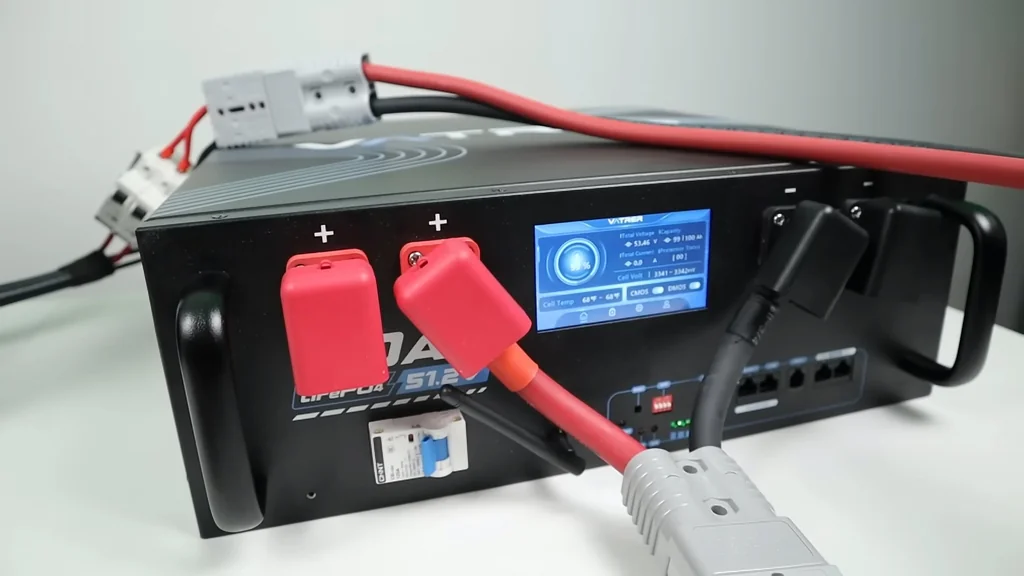
The Vatrer 51.2V 100Ah server rack battery is a solid choice for this application. It includes integrated Wi-Fi for remote monitoring, which is helpful for tracking cell health. Flip the breakers on the battery to initialize the output. Watch the power station screen for an inrush of current. It started at 7 amps and quickly dropped to 3 amps. Batteries are equalizing. This is normal behavior when connecting two different capacity sources.
Testing System Load and Discharge
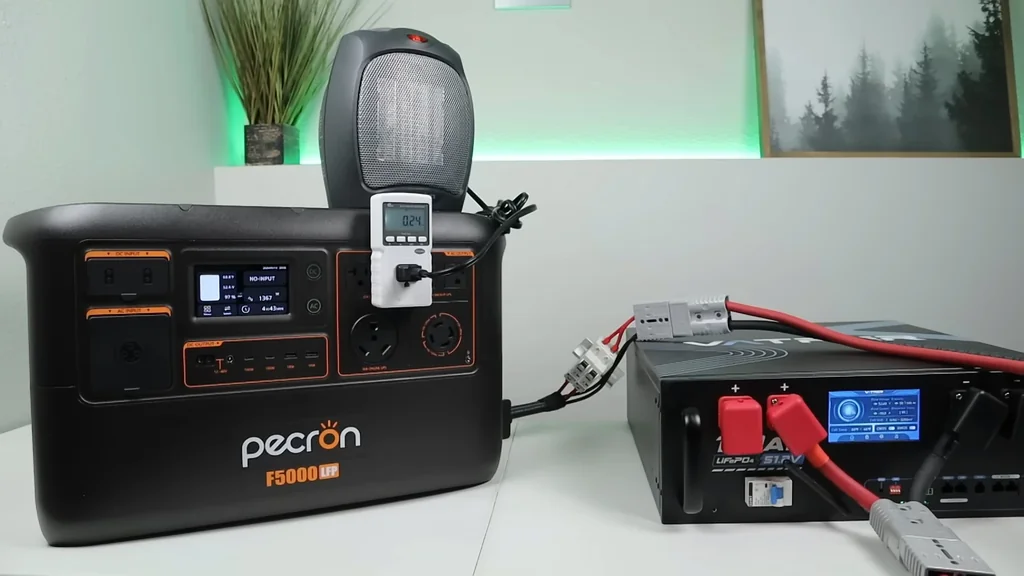
Running a 1,400W load provides a clear picture of how the system handles the combined capacity. Halfway through the test, the power station hit 50% state of charge. The estimated runtime dropped from 5 hours to 3 hours as expected. The external battery is sitting at 61% state of charge. Amperage draw from the external pack is increasing. It's working.
Calculating Total Capacity and Charging
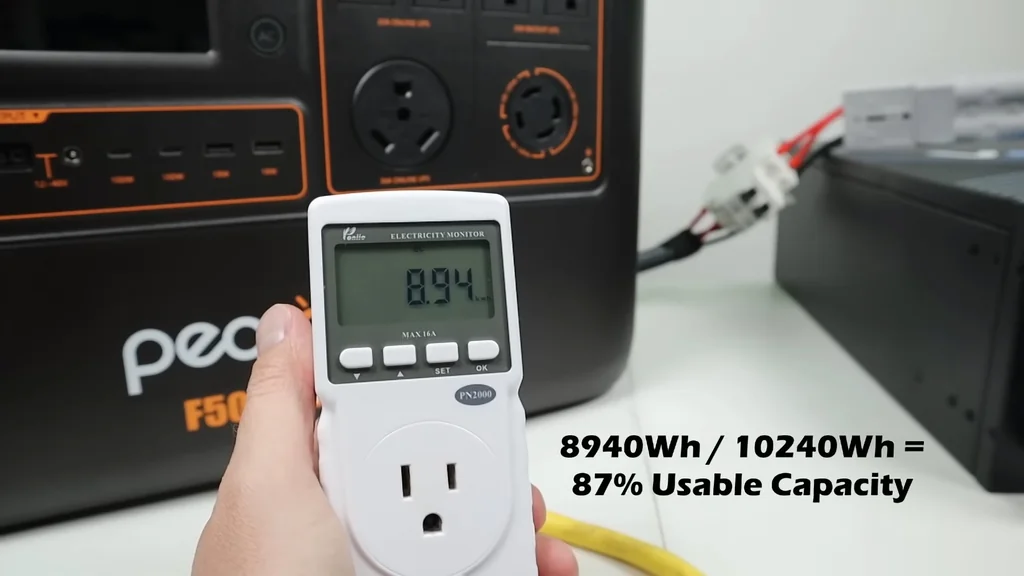
After running the capacity test, we reached 87.3% of the advertised 10,240Wh capacity. That's a decent result for this setup. Now, let's test the AC charging input to see if it tops off both the internal and external batteries. The system is pulling over 1,000W from the wall. We see 7.8 amps at 51.8 volts flowing into the battery, which accounts for about 400W of the total input. It's charging.
Stress Testing the Inverter Output
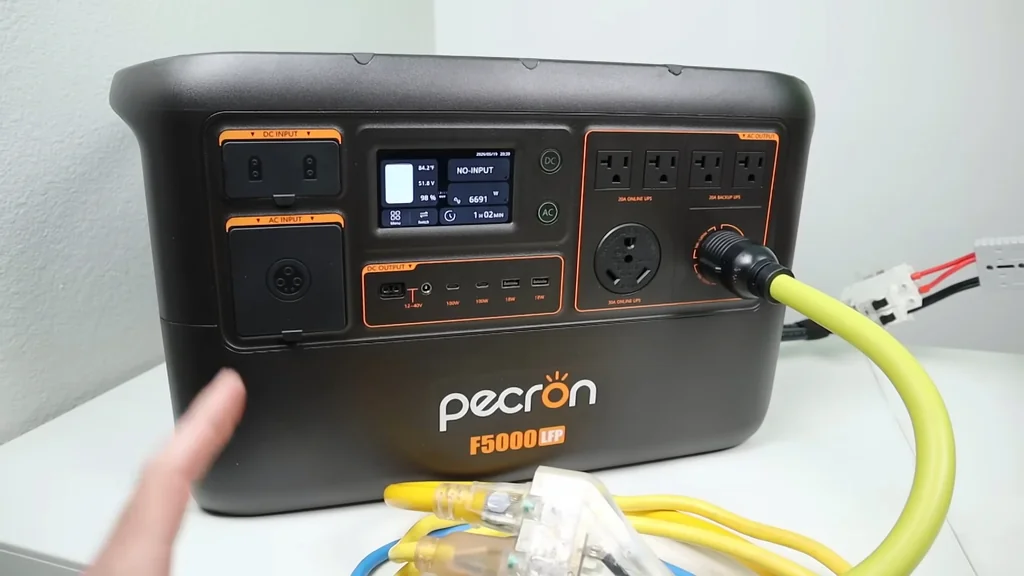
Pushing the inverter to its limits reveals how well the external battery supports high-draw scenarios. We initiated a large load through the 240V 30A output. The screen shows nearly 6,700W of total draw. After a few minutes, the state of charge dropped from 100% to 96%. We are pulling 49 amps at 52 volts, totaling about 2,400W from the battery side. It's stable.
Integrating an External Charger
To see if the system can handle external charging while connected, we hooked up a 48V 18A charger to the expansion battery terminals. This charges the external battery, which in turn feeds the power station through the adapter. We measured 17.13 amps flowing from the charger. The system manages the flow well. It's efficient.
Parallel Battery Configuration Tips
Connecting multiple batteries in parallel is straightforward if you follow basic safety rules. Always ensure every battery is at 100% state of charge before you link them together. This prevents large current spikes between packs. You can also add solar charging to the external battery, as it acts just like a standard charge controller. It's flexible.
Building the Custom Adapter Cable
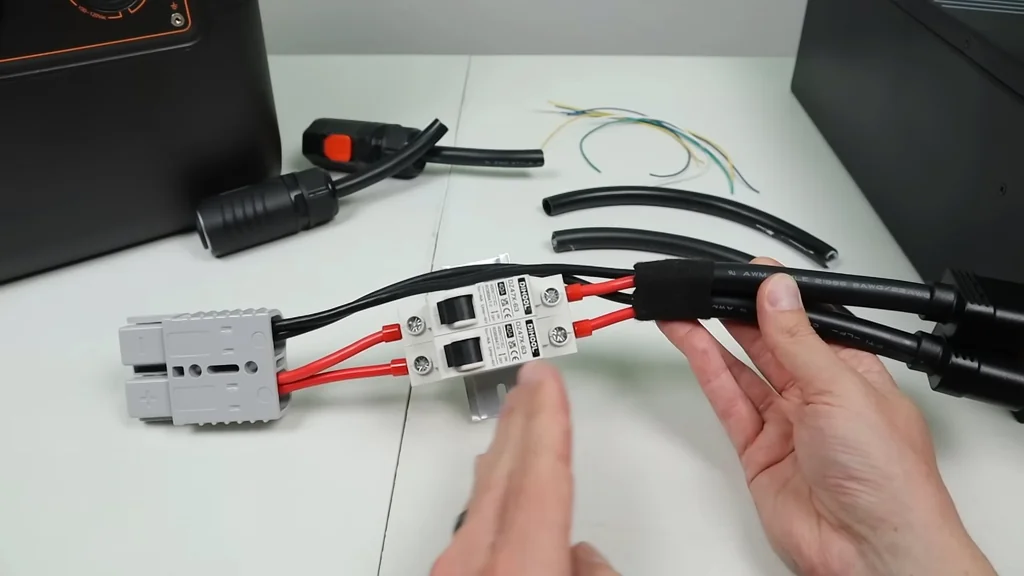
The adapter cable is the heart of this modification. I used an Anderson SB175 connector to handle the high current requirements. This provides a 175-amp rating, which is plenty for this application. The cable is terminated with high-quality lugs to ensure a low-resistance connection. It's robust.
Installing Circuit Protection
Safety is non-negotiable when dealing with high-capacity lithium banks. I installed 40A DC breakers on a DIN rail to protect the circuit. I used ferrules on the wire ends to ensure a solid connection inside the breaker terminals. The whole assembly is compact and reliable. It works.
⚠️ CAUTION: SAFETY WARNING!
High-capacity LiFePO4 batteries can discharge massive current if shorted. Always install appropriate circuit breakers and ensure all connections are properly insulated.
Summary & Tips
This modification effectively turns a standard power station into a modular energy system. The use of external server rack batteries provides a massive boost in total runtime. Proper cable fabrication and circuit protection are the keys to a reliable setup. It's a solid upgrade for any serious off-grid project.
📋 FAQ
❓ Can I use any 48V battery with the Pecron F5000?
Usually, you need to match the voltage range and chemistry. LiFePO4 is the standard, but verify your specific battery's BMS compatibility. It's not universal.
❓ Is it safe to charge the external battery while it's connected?
Yeah, it works fine as long as the total current stays within the limits of your cables and breakers. Just monitor the temperatures during the first few cycles. It's safe.
❓ Do I really need the 40A breakers?
Honestly, don't skip them. They protect your wiring and the power station from potential faults. It's cheap insurance.
❓ How do I know if my batteries are balanced before connecting?
Check the voltage of both the power station and the external pack with a multimeter. They should be within a few tenths of a volt. It's crucial.
Disclaimer: I purchased all tools for this guide with my own money to ensure an unbiased review. This post contains affiliate links, meaning I earn a small commission if you make a purchase at no extra cost to you.