Operating an oversized plug-in solar array produces significant summer energy, but maximizing utility requires careful site adjustments. I paired four 465W JA Solar modules with an EcoFlow Stream 800W microinverter to harvest 150 kWh during August. I set my ground-mount frames at a 55-degree pitch to capture low winter light while limiting top-end summer waste.
⚡ Quick Guide: How to Make It in 12 Steps
- Construct wooden ground frames at a 55-degree angle.
- Anchor frames firmly using concrete masonry units.
- Wire the four 465W panels into balanced configurations.
- Link panel outputs to the EcoFlow Stream 800W microinverter.
- Integrate the EcoFlow Smart Meter.
- Observe production metrics via the EcoFlow interface.
- Monitor grid import levels and household consumption.
- Identify solar energy lost through grid export.
- Distribute panel pairs to ensure even illumination.
- Mitigate MPPT current clipping during peak solar hours.
- Install a LiFePO4 battery storage unit.
- Rotate panel azimuth for seasonal solar optimization.
📋 In This Article
- Technical Specifications & Performance Data
- Tools & Materials Used — required project items
- Ground Mount Solar Frame Setup & Panel Selection
- Adjusting Solar Frame Tilt & Seasonal Alignment
- Ballasting DIY Frames with Heavy Concrete Blocks
- Reading Real-Time Power & August Yield Data
- Tracking July Production & Instantaneous Grid Export
- Analyzing Monthly Grid Imports & Off-Peak Tariffs
- Evaluating Excess Export vs Day Household Load
- Calculating Battery Storage ROI Potential
- Integrating the EcoFlow Stream AC5000 Battery
- Balancing Dual MPPT Inputs Across Ground Frames
- Preventing Inverter Amperage Capping & Over-Panelling
- Final Performance Takeaways & Optimization Wrap-Up
- FAQ
📊 Technical Specifications & Performance Data
| Solar Panel Array | 4x JA Solar 465W Monocrystalline Panels |
| Total Array Peak Capacity | 1,860W Peak |
| Microinverter Model | EcoFlow Stream 800W |
| Max Inverter AC Power Output | 800 Watts |
| Frame Tilt Angle | 55 Degrees (Winter-Optimized) |
| Mounting Type | DIY Wooden Ground Mount Frames |
| Frame Ballast Weight | Heavy Concrete Masonry Blocks |
| August Total Generation Output | 150.0 kWh |
| July Total Generation Output | 126.7 kWh (From July 9th) |
| August Total Grid Import | 178.77 kWh |
| August Total Grid Export | 95.0 kWh |
| Electricity Tariff | Octopus Go (Cheap rate 00:30 - 05:30) |
| Battery Storage System | EcoFlow Stream AC5000 |
| Inverter Input Topology | Dual MPPT Parallel Pair Ports |
📊 Project Overview & Costs
🔧 Difficulty Level: Easy
⏱️ Time Investment: DIY: 3 - 5 Hours | Pro: 1 - 2 Hours
💰 Professional Service Cost: $350 - $600
💡 Verdict: DIY ground mounting avoids costly roof permits and allows for simple seasonal angle adjustments.
🛠️ Tools & Materials Used
• JA Solar 465W Monocrystalline Panels
• EcoFlow Stream 800W Microinverter
• EcoFlow Smart Meter
• Dense Concrete Ballast Blocks
• DIY Wooden Ground Mount Framing Timber
Step-by-Step Assembly, Testing & Optimization
Ground Mount Solar Frame Setup & Panel Selection
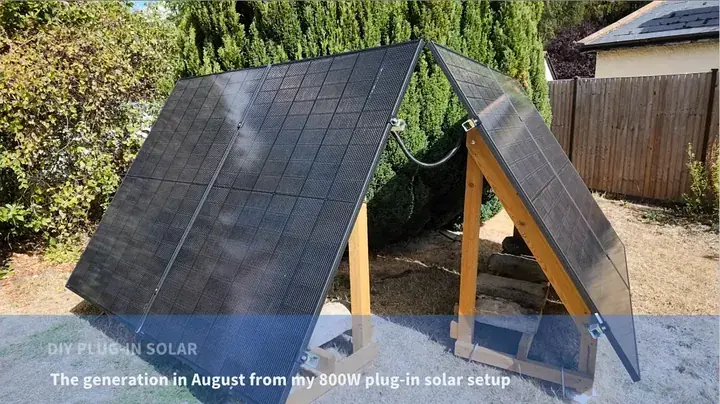
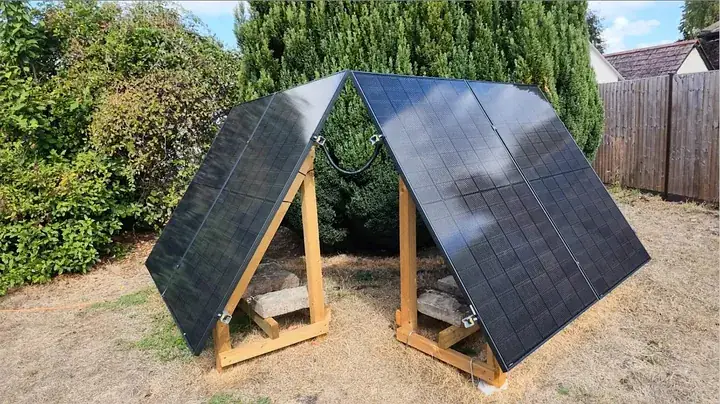
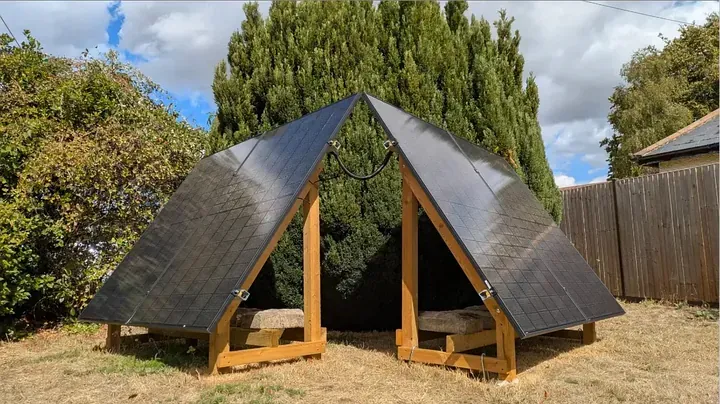
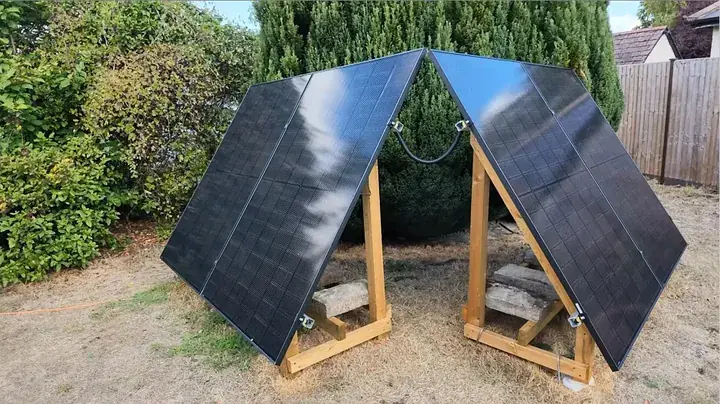
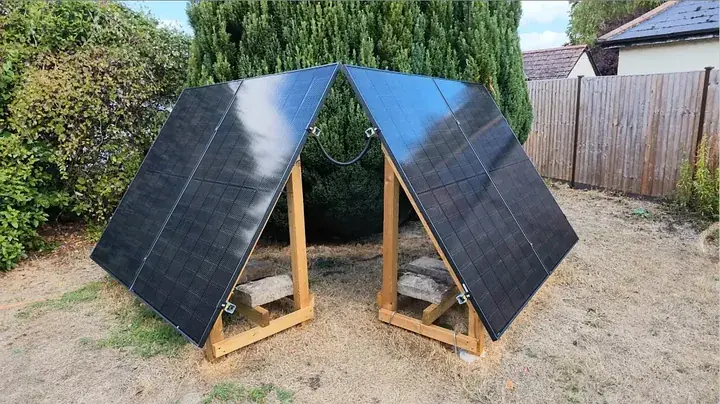
I started this garden solar project by selecting high-efficiency panels and building a sturdy support structure. I mounted four JA Solar 465W panels in pairs across custom timber frames. I cut the wood at a 55-degree tilt to capture the lower sun trajectory of late autumn and winter. The 800W grid-tied microinverter reaches capacity easily in the summer, so I focused on boosting winter performance rather than maximizing peak summer output. I didn't align the frames due south to prevent early-day inverter overload.
Adjusting Solar Frame Tilt & Seasonal Alignment
Ground mounts outperform roof systems because they allow for easy seasonal tuning. These timber frames sit on the grass without permanent concrete footings, making them simple to shift. I plan to align the frames into a straight row facing due south as we move toward winter. Fixed roof installations lock you into a static pitch, but I can reposition these frames in ten minutes. This simple adjustment recovers significant wattage during the shorter days of the year.
Ballasting DIY Frames with Heavy Concrete Blocks
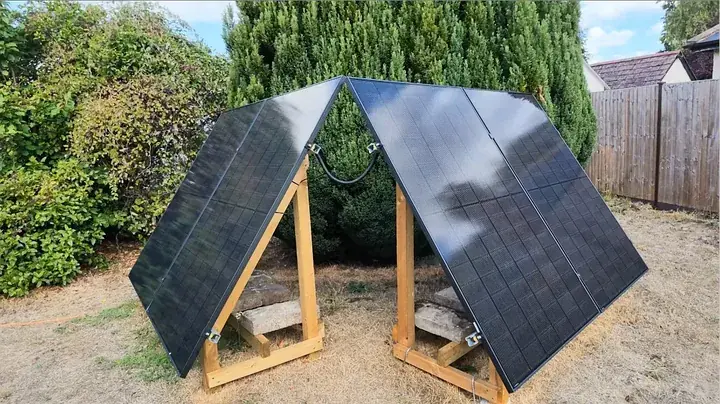
Steeply tilted solar frames act like sails in high winds. My initial attempt using short metal soil anchors wasn't enough to hold them during heavy gusts. I modified the base by screwing scrap timber across the frame to create a flat rail. I then placed heavy concrete masonry blocks over these wooden supports. The weight keeps the frames pinned to the lawn securely without requiring permanent excavation.
Reading Real-Time Power & August Yield Data
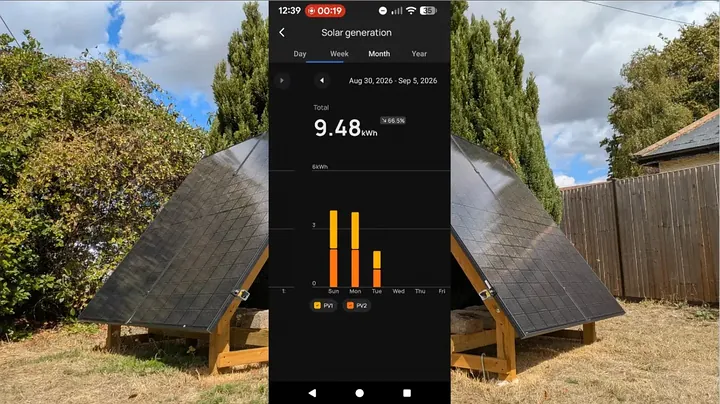
I use the EcoFlow app to monitor my microinverter performance. Even with light cloud cover, the array typically delivers between 780W and 790W. Rapid fluctuations in solar irradiance cause the output numbers to move frequently. Checking the monthly history, I saw that the four-panel system generated 150 kWh throughout August.
Tracking July Production & Instantaneous Grid Export
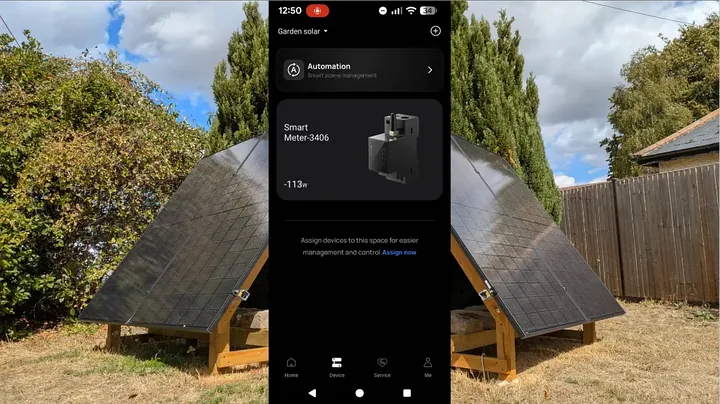
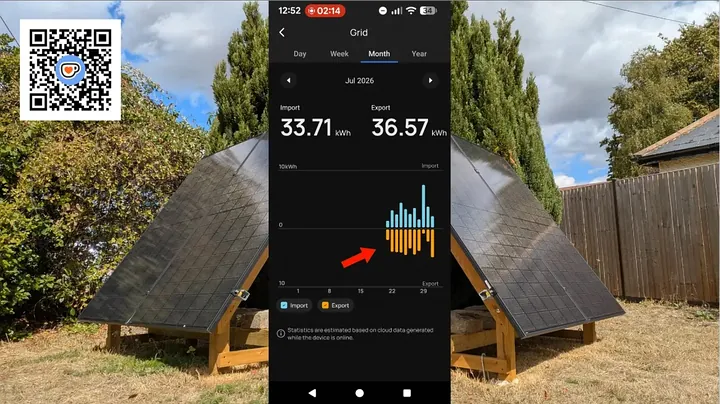
I compared my August data to the July commissioning period. The system produced 126.7 kWh starting from July 9th. The EcoFlow Smart Meter highlighted a major flaw in my setup: I lacked local storage. While the panels produced 780W, over 700W went straight to the grid because my daytime household load was minimal. I was giving away free power.
Analyzing Monthly Grid Imports & Off-Peak Tariffs
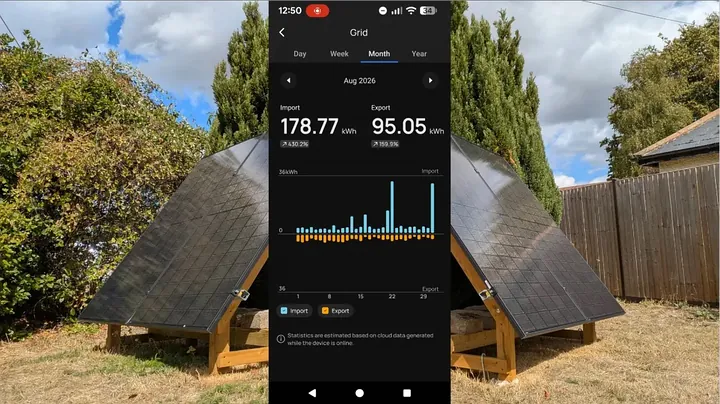
I analyzed how my energy usage aligns with my tariff structure. I imported 178.77 kWh from the grid in August. I use the Octopus Go tariff, which provides cheap power at night, so I prioritize running high-draw appliances like my dishwasher and EV charger between 00:30 and 05:30 AM to keep costs down.
Evaluating Excess Export vs Day Household Load
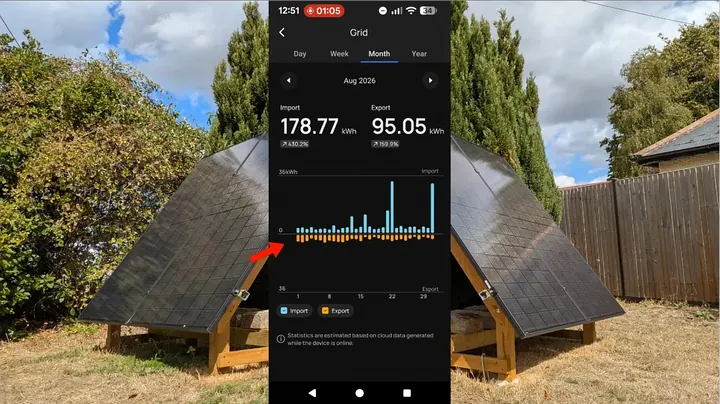
I scrutinized the relationship between my exported solar energy and my household consumption. In August, I exported about 95 kWh to the grid without compensation. This export figure nearly matches the amount of daytime grid power I bought when the sun was low. If I had stored that energy locally, I would have essentially achieved net-zero daytime usage.
Calculating Battery Storage ROI Potential
My July logs confirmed that battery storage is essential. I imported 33 kWh while exporting 36 kWh. Without a battery, I dump midday energy into the grid only to buy it back at full retail price once the sun sets. A storage bank would allow me to keep every watt I generate for my own use.
Integrating the EcoFlow Stream AC5000 Battery
I added an EcoFlow Stream AC5000 battery unit to fix my grid-dependency issues. This LiFePO4 battery stores surplus power generated during the day and discharges it during the evening. It allows me to consume my own solar power during high-demand hours rather than relying on the grid.
Balancing Dual MPPT Inputs Across Ground Frames
I improved my system efficiency by reconfiguring the DC wiring. I originally had each frame feeding its own dedicated MPPT port. This meant a single shaded panel would throttle that entire port. I changed this by pairing one panel from Frame 1 with one from Frame 2 for Port 1, then doing the same for Port 2. This cross-wired setup keeps output balanced.
Preventing Inverter Amperage Capping & Over-Panelling
I am running 1,860W of solar panels into an 800W microinverter, so I must manage current carefully. If two panels on one frame hit peak sun, they can exceed the MPPT channel's amperage limit, causing the inverter to clip the output. My cross-wired setup distributes the solar load more effectively, keeping the inverter within its safe thermal and current range.
Final Performance Takeaways & Optimization Wrap-Up
This project proves that an 800W microinverter array can handle daily household needs when the setup is managed correctly. Generating 150 kWh in one month shows the effectiveness of a DIY ground mount. Adjusting panel angles and optimizing my wiring has provided a strong return on investment without the expense of a roof-mounted installation.
⚠️ CAUTION: SAFETY WARNING!
Disconnect grid power before adjusting DC wiring. High-voltage DC from these panels can cause arcing and severe burns if you unplug MC4 connectors under load.
Summary & Tips
A DIY ground-mounted system is a cost-effective way to reduce energy bills. Over-panelling your inverter provides consistent production even when the sun is obscured. Use heavy concrete ballast to secure your frames against wind, and add battery storage to maximize your self-consumption.
📋 FAQ
❓ Can I plug an 800W microinverter into a standard wall outlet?
Microinverters are designed for standard AC sockets or dedicated spurs. Always verify your local regulations regarding ring main capacity and anti-islanding. Use a smart meter for safe monitoring.
❓ Why mount solar panels at a steep 55-degree angle?
A 55-degree tilt captures more solar irradiance during the winter months. Since the system has plenty of power in the summer, this angle helps optimize total annual yield by boosting performance when the sun is low.
❓ How do you secure DIY timber frames against wind?
Simple ground stakes are insufficient for high winds. Attach horizontal timber braces to the base and load them with concrete blocks. The added mass prevents the frames from lifting.
❓ Why cross-wire parallel solar panels?
Cross-wiring balances the solar load across the inverter's MPPT channels. This prevents a single shaded panel from limiting the entire port, ensuring even current distribution and better efficiency.
Disclaimer: I bought all equipment personally for an impartial assessment. This content includes affiliate links that generate a commission for me at no extra cost to you.