Grid failures during severe weather make marketing specs irrelevant. Maintaining cold temperatures for food storage requires knowing exact battery runtime limits under continuous compressor load. I tested the Anker SOLIX S2000 power station directly with a full-size kitchen refrigerator to evaluate discharge duration, heavy motor startup draw, pass-through UPS transfer, and solar panel replenishment rates.
⚡ Quick Guide: Refrigerator Backup & Solar Charging Steps
- Fully top off the power station battery using standard AC grid power before an incoming storm.
- Adjust AC charge rate down via the mobile app to minimize cell heating during standby prep.
- Plug your main household refrigerator into the AC output port and initiate continuous timer tracking.
- Monitor compressor draw cycles between low idling state (14W) and active cooling spikes (59W).
- Utilize pass-through AC mode with 6ms UPS failover for automated blackout transition.
- Deploy 100W–400W solar panel arrays with XT60 connectors to replenish battery banks off-grid.
- Testing Pass-Through Power and UPS Failover Speed
- Inspecting Port Configurations and Battery Lifespan
- Deploying the EverFrost 2 Portable Electric Cooler
- Configuring Dual-Zone Compressor Temperature Settings
- Examining Mechanical Features and Battery Swapping
- Connecting Folding Solar Panels to the Power Station
- Evaluating Off-Grid Solar Harvest and Cooler Charging
- Verifying Pulldown Temperatures and Runtime Totals
- Final Workshop Verdict on Emergency Battery Backup
📋 In This Article
- System Technical Specifications
- Tools & Equipment Tested — what you will need for this project
- Preparing the Anker SOLIX S2000 Station
- Configuring AC Charging Speeds via Mobile App
- Connecting the Household Inverter Refrigerator
- Tracking Long-Term Discharge and Compressor Cycles
- Testing High-Surge Heating Appliances
- Verifying Inductive and Resistive Heavy Loads
- Testing Pass-Through Power and UPS Failover Speed
- Inspecting Port Configurations and Battery Lifespan
- Deploying the EverFrost 2 Portable Electric Cooler
- Configuring Dual-Zone Compressor Temperature Settings
- Examining Mechanical Features and Battery Swapping
- Connecting Folding Solar Panels to the Power Station
- Evaluating Off-Grid Solar Harvest and Cooler Charging
- Verifying Pulldown Temperatures and Runtime Totals
- Final Workshop Verdict on Emergency Battery Backup
- FAQ
📊 System Technical Specifications
| Station Battery Capacity | 2,010Wh (314Ah) |
| Battery Cell Chemistry | LiFePO4 (Lithium Iron Phosphate) |
| Rated AC Inverter Output | 1,500W Continuous |
| Peak Bypass AC Power | 1,800W Maximum |
| AC Charging Input | 1,200W Normal / 1,600W–1,800W UltraFast |
| Solar Input Capacity | 400W Max (XT60 Connector) |
| UPS Switchover Time | ≤6ms to 10ms |
| Battery Lifecycle | 6,000 cycles to 80% / 10,000 cycles to 70% |
| Station Unit Weight | 35.7 lbs (16.2 kg) |
| Idle Inverter Draw | ~6W Power Consumption |
| Portable Cooler Capacity | 58 Liters (Dual-Zone) |
| Cooler Battery Module | 288Wh Removable LiFePO4 Pack |
📊 Project Overview & Costs
🔧 Difficulty Level: Easy
⏱️ Time Investment: DIY: 33 hours (runtime test duration) | Pro: 35 hours
💰 Equipment Cost: $1,200 - $1,800 (equipment purchase cost)
💡 Verdict: Eliminating food spoilage during a single multi-day blackout pays back a significant chunk of the station's cost.
🛠️ Tools & Equipment Tested
• C13 AC Charging Cable
• Inverter Household Refrigerator
• Portable Dual-Zone Electric Cooler
• High-Draw Countertop Toaster Oven
• Electric Drip Coffee Maker
• Handheld Hair Dryer
Step-by-Step Power Station Test & Solar Setup Procedure
Preparing the Anker SOLIX S2000 Station
Initial deployment requires establishing a complete baseline charge before running emergency tests. I positioned the Anker SOLIX S2000 unit to check the rear AC input terminal. Instead of a bulky external brick, this model uses a standard C13 computer cord plugged straight into a wall outlet. Internal charging initiated immediately upon connection. Starting at sixty percent capacity out of the box, the display estimated about 0.9 hours to reach full charge under default settings. Pulling 1,078 watts from the grid replenishes capacity fast, though thermal management remains critical for long-term cell health.

Configuring AC Charging Speeds via Mobile App
Linking the unit via Wi-Fi to the mobile app grants full access to internal BMS parameters. I opened the settings menu and adjusted the AC Recharging Power slider down from the maximum 1,200W setting to roughly 900W for routine maintenance. Lower charge rates generate less internal heat within the sealed housing, preserving cycle life. Impending storms justify switching on UltraFast mode within the app. That bypasses normal limits, pulling up to 1,800W from household wiring to refill the 2,010Wh LiFePO4 pack in under an hour. Moderate charging speeds suited this baseline test better.

Connecting the Household Inverter Refrigerator
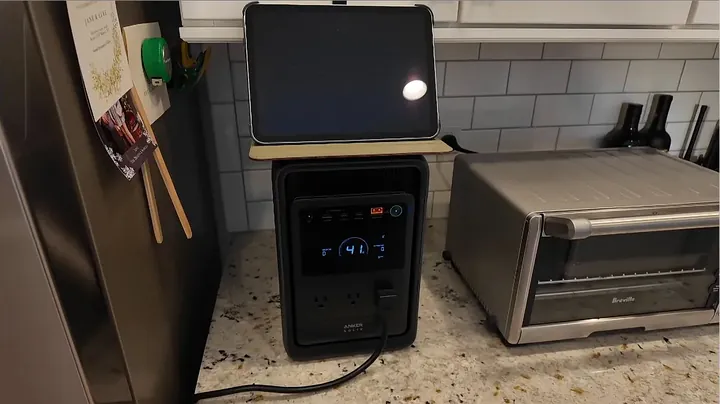
Battery capacity reached 100%, so I unplugged the unit and moved the 35.7 lb station to the kitchen. Recessed side handles provide secure lifting points without protruding parts that break under load. I plugged a full-size residential refrigerator cord into the front AC panel and threw the inverter switch at 3:50 PM, starting an iPad timer. Modern inverter compressors avoid the massive surge currents associated with older single-speed motors. The station screen registered 14 watts during idle periods. Furthermore, the internal inverter draws only 6 watts on standby, outperforming competing models that idle at 15W to 20W.

Tracking Long-Term Discharge and Compressor Cycles
Measuring actual backup endurance demands logging watt-hour draw across ambient temperature swings and compressor cycles. At 11:47 PM—roughly eight hours in—the battery dropped to 80%, indicating the fridge consumed 20% of the 2,010Wh capacity through an evening of normal door openings. Low idle draw proves essential for total runtime. Battery percentage hit 41% at 12:50 PM on day two, spanning 20 hours and 59 minutes. By 10:11 PM—30 hours and 21 minutes total—capacity reached 17% while outputting 59 watts during an active cooling cycle. The system projected another 4.8 hours remaining. I concluded the test at 33 hours of continuous runtime with 10% battery reserve intact, preserving food without fully depleting the cells.
Testing High-Surge Heating Appliances
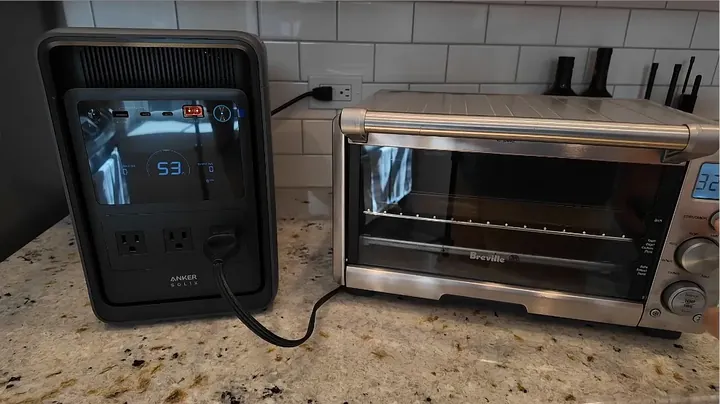
Emergency power units must handle heavy resistive loads and inductive spikes without triggering thermal cutoffs. I plugged a countertop toaster oven into the AC bank and ran a full toast cycle to test the sine wave inverter. The S2000 spiked output to 1,700 watts peak before stabilizing at a continuous 1,300 watts. Internal MOSFET components managed the 1,300W load without throwing overload codes. Cooling fans spun up under the strain, but acoustic noise remained controlled. Hot meals remain possible during grid failures without relying on a combustion generator.
Verifying Inductive and Resistive Heavy Loads
Subsequent bench testing involved an electric coffee maker and a high-wattage hair dryer. Water pumping in the coffee maker registered 6 watts, jumping to 1,387 watts once the heating element engaged. Powering heating elements and motors simultaneously requires stable pure sine wave delivery to avoid voltage drop. The S2000 supplied the coffee brewer heater and hair dryer motor without frequency distortion or voltage sag across mixed resistive loads.

Testing Pass-Through Power and UPS Failover Speed
Uninterruptible Power Supply (UPS) pass-through functionality remains vital for automated backup. I connected the S2000 to grid power while running a lamp from the front AC panel. The display showed 1,087 watts input and 8 watts output. Pulling the main supply cord from the wall tested transfer speed. The internal relay switched in under 6 milliseconds without causing a visible flicker in the lamp filament. Leaving refrigerators connected in pass-through mode ensures seamless transition during unexpected blackouts.

Inspecting Port Configurations and Battery Lifespan
Physical inspection highlighted solid construction and practical layout. The front panel incorporates two USB-C fast-charge ports, a USB-A port, an XT60 solar input socket, and three grounded AC outlets. The rear houses two additional AC receptacles, cooling exhaust vents, and the main AC power socket. High-density 314Ah LiFePO4 cells inside support 6,000 cycles to 80% capacity or 10,000 cycles to 70%. This chemical stability provides extended service life compared to older NCM chemistries that degrade after 500 to 800 cycles.

Deploying the EverFrost 2 Portable Electric Cooler
Transporting a full-size refrigerator during evacuation or camping is impractical. I tested the Anker SOLIX EverFrost 2 58-liter dual-zone electric cooler outdoors on grass in direct sunlight to simulate field conditions. Infrared thermal readings recorded a 91°F ground temperature, with internal compartment walls measuring 79°F to 80.4°F prior to activation. Dual-zone compressor coolers utilize insulated walls and efficient DC compressors to maintain sub-freezing temperatures without ice.

Configuring Dual-Zone Compressor Temperature Settings
Powering on the EverFrost 2 activated the digital interface. The screen remained legible in sunlight, displaying initial temperatures of 72°F and 68°F. I set the left zone to 0°F for freezing and the right zone to 30°F for refrigeration. Independent dual zones allow simultaneous storage of frozen goods and fresh items. The variable-speed DC compressor spins up smoothly, drawing minimal power from its internal battery during pulldown.

Examining Mechanical Features and Battery Swapping
Accessing the side compartment exposes the removable 288Wh LFP battery module. The battery includes USB-A and USB-C ports to function as a standalone power bank, alongside an LED charge indicator. Hardware details show thoughtful outdoor design. The pull handle features a drop-down support bracket converting it into a side table. Integrated features include a cast metal bottle opener and a molded measurement scale on the lid.

Connecting Folding Solar Panels to the Power Station
Off-grid recharging necessitates a reliable photovoltaic setup. I deployed two Anker 100W folding monocrystalline panels on the grass, angled toward the sun. Connecting via weather-sealed XT60 cables, I plugged the array into the front solar port of the S2000. XT60 connectors deliver low-resistance current transfer, preventing voltage drop compared to basic barrel jacks. The S2000 controller accepts up to 400W of solar input, accommodating expansion arrays during extended grid outages.

Evaluating Off-Grid Solar Harvest and Cooler Charging
Despite overhead tree cover and broken clouds, the internal MPPT controller locked onto the array, registering 67 to 68 watts input. Direct sunlight yields 160W to 180W from a 200W array configuration. Included wiring adapters permit direct connection to the EverFrost cooler's XT60 port. This cross-compatibility allows simultaneous charging of both the power station and the cooler from a single solar array.

Verifying Pulldown Temperatures and Runtime Totals
Testing the EverFrost cooler in 96.4°F ambient heat, I verified internal temperatures using an infrared thermometer. The freezer section dropped from 79°F to 10°F, while the refrigerator side stabilized at 23°F. Combining efficient insulation with low compressor power draw maintains food preservation during extreme heat. Using the S2000 as an auxiliary power source extends portable cooling duration to multiple days without fossil fuels.

Final Workshop Verdict on Emergency Battery Backup
Real-world testing of 2,010Wh of LiFePO4 capacity validates that portable power stations replace traditional gas generators for emergency refrigeration. Delivering 33 continuous hours of runtime with 10% reserve confirms the manufacturer's claims. Pairing a low-idle power station with solar panels and portable cooling creates a capable off-grid setup. The S2000 handles high-wattage appliance surges, executes fast UPS transfers, and provides adequate energy density for critical household supplies.
⚠️ CAUTION: SAFETY WARNING!
Verify AC load demands remain within rated inverter limits. Never operate power equipment in standing water or unshielded outdoor rain.
Summary & Tips
Testing demonstrates that a 2,010Wh LiFePO4 power station sustains an inverter refrigerator for 33 hours during grid interruptions. Low idle consumption preserves battery capacity while compressors cycle intermittently. Integrating solar array harvesting extends operation indefinitely during extended outages, offering a silent alternative to combustion generators.
📋 Frequently Asked Questions
For sensitive electronics, LED lighting, and motors (fans, compressors), yes. Pure sine eliminates electrical buzz, heat, and flicker. However, it comes with a trade-off: in our real-world testing, the pure sine unit had a standby idle draw of 12W compared to just 2.6W on the modified sine inverter.
Modified sine waves do not produce a smooth curve; they switch voltage in abrupt, stepped square waves. Inductive motor windings react to these sharp harmonic transitions with physical vibration and excess heat, creating an audible electrical hum.
At 12W of continuous idle power (approx. 0.97A at 12.4V), leaving the pure sine inverter on 24/7 consumes roughly 288Wh per day without any load plugged in. On a 100Ah 12V battery (~1,200Wh capacity), standby loss alone drains nearly 25% of your total storage daily.
Compact LED drivers and capacitive power supplies struggle to filter the rapid voltage steps of modified sine waves. The internal circuitry charges and discharges unevenly at harmonic frequencies, resulting in visible strobe flicker on camera and to the eye.
When powering the fan, DC input current rose from 2.63A on modified sine to 3.16A on pure sine. This increase was entirely driven by the higher baseline idle draw of the larger 400W pure sine inverter rather than an inefficiency in powering the fan motor itself.
Most modern switch-mode power supplies will work, but high harmonic distortion causes internal switching components and inductors to emit coil whine and run noticeably hotter, which can reduce their operating lifespan over time.
Purely resistive loads like incandescent lights, heating elements, basic soldering irons, and universal brushed power tools (drills, angle grinders) operate normally without issues on modified sine wave inverters.
Disclaimer: Equipment acquired independently for evaluation purposes. Links included may generate affiliate commissions without additional cost to the buyer.